Friday, November 15, 2013
Wednesday, October 23, 2013
Fragments by Hugh Irvine
Fragments is a collection of eight very short vignette-like short stories, that give the reader windows onto various people's lives. The stories are set in various stages of life, childhood, work, holiday and terminal illness.
The two stories that stood out for me are 'We are so Sorry' which offers a touching indight into the relationship between a terminally ill man and the nurse looking after him and 'Humidity' in which a boy realises his cat has found the best way of dealing with hot and humid weather.
The stories are very readable, seem true to life and are written with a good eye for detail.Their short length makes them ideal to read when you have a spare couple of minutes.
Disclaimer: I received a free e-copy of this book via Story Cartel.
The two stories that stood out for me are 'We are so Sorry' which offers a touching indight into the relationship between a terminally ill man and the nurse looking after him and 'Humidity' in which a boy realises his cat has found the best way of dealing with hot and humid weather.
The stories are very readable, seem true to life and are written with a good eye for detail.Their short length makes them ideal to read when you have a spare couple of minutes.
Disclaimer: I received a free e-copy of this book via Story Cartel.
Sunday, October 13, 2013
She Thought She had Lost Something
When she was five, she
thought she had lost something.
She wasn't sure what,
the pain and discomfort were overwhelming and no-one told her
anything.
When she was twelve,
she thought she had lost something.
The blood dripping
slowly, every month five days of fever and pain.
When she was eighteen
she thought she had lost something.
Feeling only pain, as
her husband cut her open again before penetrating her, no love in the
act.
When she was nineteen,
she thought she had lost something.
Cut open to give birth
to a daughter, sewn back again, months of fever and pain.
When she was
twenty-four, she thought she had lost something.
Bringing the
circumciser round to cut her daughter with unsterilised glass.
When she was still
twenty-four, she knew she had lost something.
Watching her five-year
old daughter bleed slowly to death in fever and pain.
**
You can read more about female genital mutilation on the WHO website.
**
This is an entry for the FEMFLASH 2013 writing competition from Mookychick Online. Enter now.
**
As ever, coloured text contains hyperlinks that thae you to other webpages where you can find out more.
Wednesday, September 25, 2013
Vienna
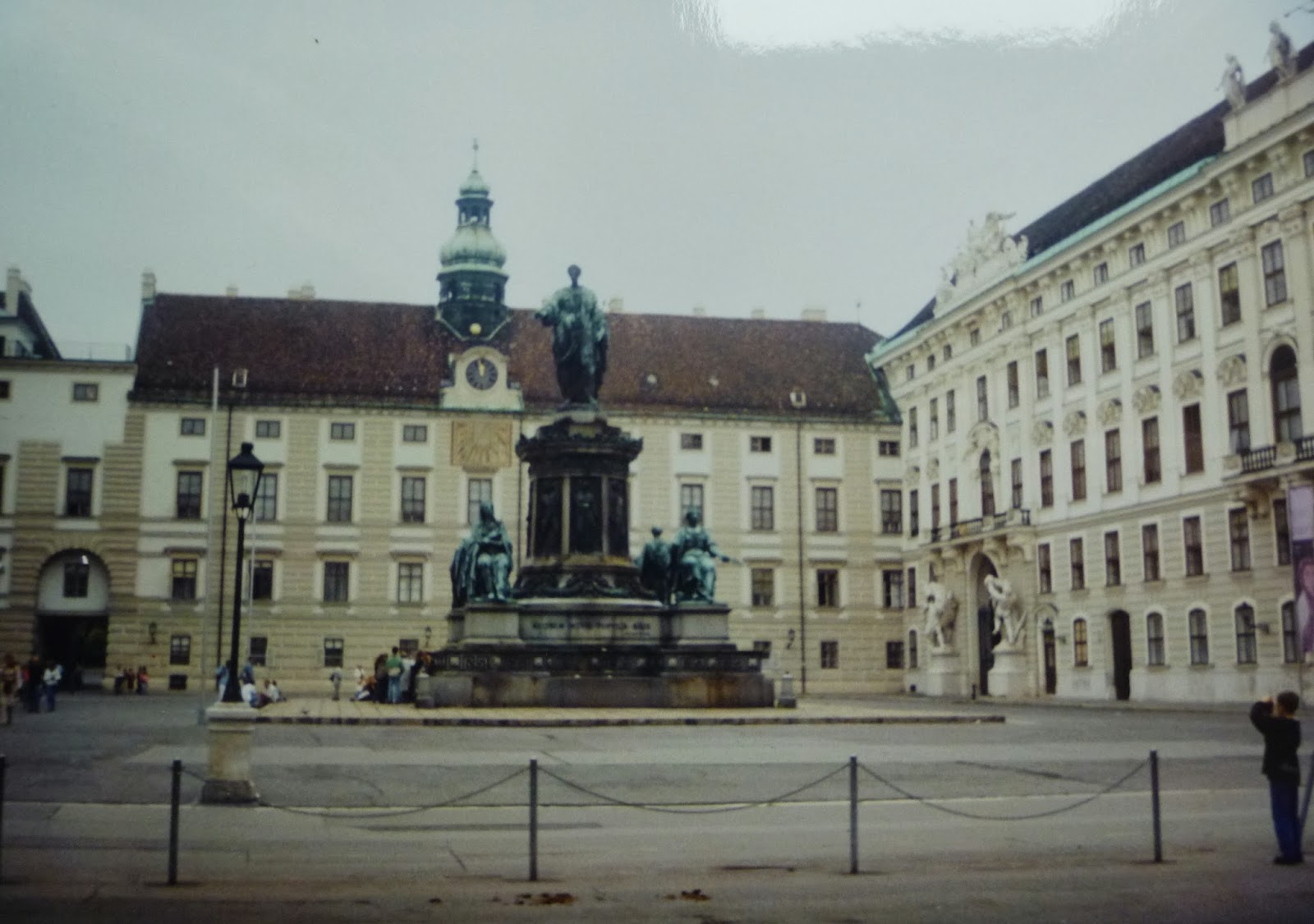
Seeing the film Museum Hours, which I reviewed yesterday reminded me of my trip to Vienna in 1998. Here are some of my favourite photos from the trip:
The Hundertwasser House, designed by architect, artist and ecologist Hundertwasser.
A wonderful and fascinating building!
The Glorieta at Schloss Schönbrunn.
Karlsplatz - an Underground Station that became a cafe.
a pretty street corner
does anyone know the name of this building in the centre of Vienna?
Albertina Platz Memorial against War and Fascism
By Austrian artist Alfred Hrdlicka
[1928-2009]. This square is the site of a massacre in 1945 when an
Allied bomb killed an unknown number of civilians taking shelter in the
basement of a building.
As ever, coloured text contains hyperlinks that take you to other webpages where you can find out more.
Tuesday, September 24, 2013
Museum Hours
Museum Hours is the story of Anne, a Canadian woman in Vienna to care for a distant relative who has fallen into a coma. She speds a lot of time in the city's Art History Museum and is befriended by one of the guards there who acts as her unofficial guide to the museum and to selected aspects of the city.
The two discuss the meaning and value of art, politics and their life experiences, while wandering round the Museum, various coffee shops and the wintry streets of Vienna.
The film sometimes feels like an advert for the museum and in particular its Breughel collection, though the wider city doesn't come out of it looking quite so wonderful, as the clouds never seem to lift and the camera lingers on building sites and run down street corners.
However the film is a particularly intelligent tour guide, juxtaposing as it does scenes from the museum alongside the flea markets of the city centre and taking a tour into the underworld of a lake grotto just as Anne's relative slips into death.
Its a lovely, meditative film for anyone interested in art history or in Vienna.
Museum Hours is on at Edinburgh Filmhouse until Thursday 26 September.
**
The film reminded me of my visit to Vienna, many years ago now and I may see if I can transfer some of my photos onto the computer and write about the visit!
The two discuss the meaning and value of art, politics and their life experiences, while wandering round the Museum, various coffee shops and the wintry streets of Vienna.
The film sometimes feels like an advert for the museum and in particular its Breughel collection, though the wider city doesn't come out of it looking quite so wonderful, as the clouds never seem to lift and the camera lingers on building sites and run down street corners.
However the film is a particularly intelligent tour guide, juxtaposing as it does scenes from the museum alongside the flea markets of the city centre and taking a tour into the underworld of a lake grotto just as Anne's relative slips into death.
Its a lovely, meditative film for anyone interested in art history or in Vienna.
Museum Hours is on at Edinburgh Filmhouse until Thursday 26 September.
**
The film reminded me of my visit to Vienna, many years ago now and I may see if I can transfer some of my photos onto the computer and write about the visit!
Saturday, September 21, 2013
City Centre Reflections
I took this photo from the bus as we waited for the lights to change.
This street used to only be used by a few buses, but since the saga of Edinburgh's tram works began, diversions have been in place and all buses in this area of town now use this street.
Apparently the trams will start running next Spring.....
For Weekend Reflections
This street used to only be used by a few buses, but since the saga of Edinburgh's tram works began, diversions have been in place and all buses in this area of town now use this street.
Apparently the trams will start running next Spring.....
For Weekend Reflections
Wednesday, September 18, 2013
Tuesday, August 27, 2013
Desert Flower by Waris Dirie
This is the story of Waris Dirie, a Somalian nomad who ran away from home to escape an arranged marriage with a much older man, found her way to London, where she worked as a maid in the Somalian Embassy and then at MacDonalds before becoming a supermodel and then a UN Special Ambassador for the Elimination of Female Genital Mutilation. It's an amazing book, full of life and a passionate commitment to women's rights along with descriptions of female genital mutilation that will convince every reader that this is a practice that ought to be banned everywhere. It is not something that can be respected as a cultural practice, it is gross mutilation of women's bodies that can cause lifelong suffering if the woman doesn't die in the process.
Female Genital Mutilation has been banned in Egypt and is decreasing in many African countries. Unfortunately it is still carried out in some African communities in some countries outside Africa.
Links:
The Waris Dirie Foundation
FORWARD - Foundation for Women's Health, Research and Development
As ever, coloured text contains hyperlinks that take you to other webpages where you can find out more.
Female Genital Mutilation has been banned in Egypt and is decreasing in many African countries. Unfortunately it is still carried out in some African communities in some countries outside Africa.
Links:
The Waris Dirie Foundation
FORWARD - Foundation for Women's Health, Research and Development
As ever, coloured text contains hyperlinks that take you to other webpages where you can find out more.
Monday, August 19, 2013
The Incorporation of Baxters
Sunday, August 11, 2013
The Lacuna by Barbara Kingsolver
The
Lacuna is the story of Harrison Shepherd a Mexican American writer who
is born in the USA but grows up in Mexico. He works for a while with
Frida Kahlo and Diego Rivera, round the time when Trotsky is living with
them.
Shepherd then moves to the US, becomes a writer and gets caught up in the anti communist witch hunts after the second world war.
There's a lot I loved about the book, the writing is excellent and the issues raised by the book are thought provoking. Specially the contrast between the relationship between art and politics in Mexico and in the US. Then the fact that Shepherd writes historical fiction that has disguised relevance to the times he lives in, presented in a historical novel that has (disguised) relevance to the times we read it in (issues round censorship and in scapegoating groups we're suspicious of).
I like the way the book is put together, diaries, fictional reviews of Shepherd's books, letter and newspaper articles. Though I am aware that this may not work for all readers.
I'm always uncomfortable though when real characters from history are shown in fiction intereacting so closely with fictional characters that effectively history is rewritten. Shepherd didn't exist, so the stories that centre round him and Kahlo, Rivera and Trotsky aren't true, though those other characters are real and have real stories.
Overall though it's an impressive book and well worth reading
Shepherd then moves to the US, becomes a writer and gets caught up in the anti communist witch hunts after the second world war.
There's a lot I loved about the book, the writing is excellent and the issues raised by the book are thought provoking. Specially the contrast between the relationship between art and politics in Mexico and in the US. Then the fact that Shepherd writes historical fiction that has disguised relevance to the times he lives in, presented in a historical novel that has (disguised) relevance to the times we read it in (issues round censorship and in scapegoating groups we're suspicious of).
I like the way the book is put together, diaries, fictional reviews of Shepherd's books, letter and newspaper articles. Though I am aware that this may not work for all readers.
I'm always uncomfortable though when real characters from history are shown in fiction intereacting so closely with fictional characters that effectively history is rewritten. Shepherd didn't exist, so the stories that centre round him and Kahlo, Rivera and Trotsky aren't true, though those other characters are real and have real stories.
Overall though it's an impressive book and well worth reading
Subscribe to:
Posts (Atom)