you can't even see me
but i dream you can read my mind
judging my impure motives
as i jump up and down
at your window
the man in the moon
has left the room
trailing memories
of parallel lives
but it wasn't you
or was it
my Harlequin?
(and now the mystery begins)
Sunday, May 16, 2010

Sunday, April 25, 2010
Saturday, April 17, 2010


Tuesday, April 13, 2010
Unthinkable Skies launch
Unthinkable Skies my poetry chapbook will be launched 6.30pm, Wednesday 12 May at Water of Leith Conservation Trust Visitor Centre, Slateford Road, Edinburgh. There will be refreshments and music!
Monday, April 12, 2010
Fragile Beauty
Out of the crowd she appears
bright with her smile and her colours,
perfume in clouds, bells on her wrists,
beauty and youth on her side.
She’s glowing happy with friends,
hands holding hands and sparkling eyes,
comfort in closeness and conversation,
laughter and love all around.
She lifts her hand to long auburn hair,
the sleeve falling back to reveal
ugly red weals, scars of self-harm
across her wrists and her arm.
bright with her smile and her colours,
perfume in clouds, bells on her wrists,
beauty and youth on her side.
She’s glowing happy with friends,
hands holding hands and sparkling eyes,
comfort in closeness and conversation,
laughter and love all around.
She lifts her hand to long auburn hair,
the sleeve falling back to reveal
ugly red weals, scars of self-harm
across her wrists and her arm.
Previously published in Envoi
Friday, March 26, 2010

Monday, March 22, 2010
Unthinkable Skies
My poetry chapbook Unthinkable Skies is now available! You can order it from: http://www.calderwoodpress.co.uk/ and overseas orders are welcome.
The title Unthinkable Skies is taken from one of the poems in the collection and most of the poems feature the sky in some way. Yes there are lots of birds in there but lots of other themes to interest the non-birdwatchers among you. There will be a launch event at some point and I'm hoping to do several other readings over the next few months, mostly in Edinburgh but also in other parts of Scotland and even perhaps in Manchester and Bristol, depending on opportunities.
I'll keep you up to date on these kind of things, though I hope not to become boring about it. You can always check this post here for updates of what I'm doing.
The title Unthinkable Skies is taken from one of the poems in the collection and most of the poems feature the sky in some way. Yes there are lots of birds in there but lots of other themes to interest the non-birdwatchers among you. There will be a launch event at some point and I'm hoping to do several other readings over the next few months, mostly in Edinburgh but also in other parts of Scotland and even perhaps in Manchester and Bristol, depending on opportunities.
I'll keep you up to date on these kind of things, though I hope not to become boring about it. You can always check this post here for updates of what I'm doing.
Wednesday, March 03, 2010
Twitter as a Marketing Tool for Writers
As some of you may know, I recently joined Twitter. I recently did an online marketing scoping exercise for the charity I work for. While doing this I spent a lot of time on Twitter and realised that I could use it personally. In the first week I found myself with 50 followers and currently have a few over 100 after 3 weeks. Now these aren't huge numbers but they're not bad. Plus a lot of these people are people who didn't know me before I joined Twitter. I've already had Twitter contacts starting to follow my blogs, friending me on Facebook and offering to publicise my forthcoming poetry chapbook.
You can use Twitter in many ways but if you're looking for new audiences for your writing, your blog or your art there are ways you can maximise the marketing potential of Twitter.
1. Think about it first. Look at a few Twitter accounts before setting up your own. Or go to the homepage and search on a topic that interests you. Find out how people are using Twitter and what they're saying.
2. Start out with confidence. It's fine to set up an account quietly and then spend time thinking about how you want to use it but once you start, it's good to sound as though you know why you're there rather than tweeting (posting) 'Not sure why I'm here' twenty times.
3. Have an idea of what you want to say. General chit chat is fine and that's why a lot of people use Twitter. If you're using it for marketing though, it's useful to tweet about your writing and about things that fit in with the persona you want to project. Unless you're famous, people who don't know you are likely not to be interested in very personal chit chat. At the same time make sure you don't only tweet to market your work, because if you do that people will become bored very easily. Some people successfully use Twitter as a noticeboard where they purely post occasional marketing notices, but that misses out on the huge potential the medium offers. I tweet mostly about nature, crafts and poetry, plus I post short poems, links to highlights from my blogs and notices about my poetry. If you're on both Facebook and Twitter, try not to say exactly the same on both, specially if your audience is the same in each case.
4. Follow people! Lots of bloggers use Twitter so follow some of the people whose blogs you read. Find new people to follow too! If you follow people, they may follow you back (though following is not necessarily a two way process. Some people stop following you if you don't follow them back, but you don't need to follow everyone who follows you - some will be spambots, some will just want to sell you stuff, others you may just not find interesting). Getting the highest number of followers shouldn't be the aim in Twitter, it's best to have relatively few followers who are really interested rather than a thousand followers who never read you. You can list people in Twitter and make a 'favourites list' for the days when you're too busy to read everyone's tweets.
5. Retweet things of interest. If your favourite poet has just posted a wonderful haiku or a charity you follow has just posted some vital news you can share that with your followers by retweeting it. This helps to make you popular and shows you're interested in engaging with the medium. It can also help to build your Twitter persona.
6. Use hash tags. Hash tags are a way that Twitter uses to group tweets on the same topic. Some of my favourite hash tags are: #haiku; #senryu; #tanka; #micropoetry; #birds. If you add a hash tag to your tweet then other people interested in that topic will pick up your tweets and may start following you or re-tweeting you as a result.
7. Talk to other people on Twitter. If you include someone's Twitter name (eg @craftygreenpoet) in a tweet, even if you don't follow each other then that person will get your message. Doing this, the messages are readable by anyone. Twitter also offers a private message service.
I now prefer Twitter to Facebook and Myspace, which is ironic because when I first started out on the online social marketing lark, I thought Twitter was the one I would never use! Twitter certainly has proven more useful to me in terms of finding new audience for my work and also in terms of finding new writers I'm interested in.
I'm hoping eventually to write a different version of this article for non-profits for the Information Officer Support Group blog which I contribute to.
For a longer guide to using Twitter to market your work as a writer, please read Debbie Ridpath's excellent guide at: http://www.inkygirl.com/a-writers-guide-to-twitter/
You can use Twitter in many ways but if you're looking for new audiences for your writing, your blog or your art there are ways you can maximise the marketing potential of Twitter.
1. Think about it first. Look at a few Twitter accounts before setting up your own. Or go to the homepage and search on a topic that interests you. Find out how people are using Twitter and what they're saying.
2. Start out with confidence. It's fine to set up an account quietly and then spend time thinking about how you want to use it but once you start, it's good to sound as though you know why you're there rather than tweeting (posting) 'Not sure why I'm here' twenty times.
3. Have an idea of what you want to say. General chit chat is fine and that's why a lot of people use Twitter. If you're using it for marketing though, it's useful to tweet about your writing and about things that fit in with the persona you want to project. Unless you're famous, people who don't know you are likely not to be interested in very personal chit chat. At the same time make sure you don't only tweet to market your work, because if you do that people will become bored very easily. Some people successfully use Twitter as a noticeboard where they purely post occasional marketing notices, but that misses out on the huge potential the medium offers. I tweet mostly about nature, crafts and poetry, plus I post short poems, links to highlights from my blogs and notices about my poetry. If you're on both Facebook and Twitter, try not to say exactly the same on both, specially if your audience is the same in each case.
4. Follow people! Lots of bloggers use Twitter so follow some of the people whose blogs you read. Find new people to follow too! If you follow people, they may follow you back (though following is not necessarily a two way process. Some people stop following you if you don't follow them back, but you don't need to follow everyone who follows you - some will be spambots, some will just want to sell you stuff, others you may just not find interesting). Getting the highest number of followers shouldn't be the aim in Twitter, it's best to have relatively few followers who are really interested rather than a thousand followers who never read you. You can list people in Twitter and make a 'favourites list' for the days when you're too busy to read everyone's tweets.
5. Retweet things of interest. If your favourite poet has just posted a wonderful haiku or a charity you follow has just posted some vital news you can share that with your followers by retweeting it. This helps to make you popular and shows you're interested in engaging with the medium. It can also help to build your Twitter persona.
6. Use hash tags. Hash tags are a way that Twitter uses to group tweets on the same topic. Some of my favourite hash tags are: #haiku; #senryu; #tanka; #micropoetry; #birds. If you add a hash tag to your tweet then other people interested in that topic will pick up your tweets and may start following you or re-tweeting you as a result.
7. Talk to other people on Twitter. If you include someone's Twitter name (eg @craftygreenpoet) in a tweet, even if you don't follow each other then that person will get your message. Doing this, the messages are readable by anyone. Twitter also offers a private message service.
I now prefer Twitter to Facebook and Myspace, which is ironic because when I first started out on the online social marketing lark, I thought Twitter was the one I would never use! Twitter certainly has proven more useful to me in terms of finding new audience for my work and also in terms of finding new writers I'm interested in.
I'm hoping eventually to write a different version of this article for non-profits for the Information Officer Support Group blog which I contribute to.
For a longer guide to using Twitter to market your work as a writer, please read Debbie Ridpath's excellent guide at: http://www.inkygirl.com/a-writers-guide-to-twitter/
Friday, February 26, 2010
You Were More Interesting before I Met You
No, not you, the reader
but you of the once long email conversations
discussing philosophy, your thoughts
about poetry, your favourite films,
how you love Autumn
and the sound of the rain.
But since we met
all you do is complain
again and again
about your job, your flatmates
and the endless rain.
When your complaints
finally end (unlike the rain)
you turn on me
with the white glare of interrogation
and say: You,
now you must talk
and just as when I walk
onto stage
under that bright white glaring light
my mind empties
and I take on the persona
of frightened rabbit
in front of headlights
and I forget everything I wanted to say.
but you of the once long email conversations
discussing philosophy, your thoughts
about poetry, your favourite films,
how you love Autumn
and the sound of the rain.
But since we met
all you do is complain
again and again
about your job, your flatmates
and the endless rain.
When your complaints
finally end (unlike the rain)
you turn on me
with the white glare of interrogation
and say: You,
now you must talk
and just as when I walk
onto stage
under that bright white glaring light
my mind empties
and I take on the persona
of frightened rabbit
in front of headlights
and I forget everything I wanted to say.
Friday, January 29, 2010
Novel Reflections
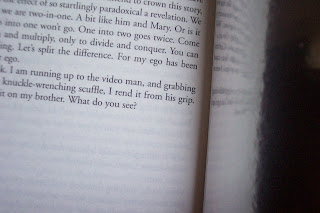 The Myth of Exile and Return by Desmond Traynor is a strange story of a man who stays at home and inhabits his twin brother's mind as he travels the world. It is very cleverly written with lots of wordplay that does risk verging on the irritating but mostly works for me. Lots of literary allusions too, but mostly of the sort where the phrases make sense even if you don't the original work they're alluding to. I really enjoyed the book and this is a delightful mirror on page 283 that reflects page 282....
The Myth of Exile and Return by Desmond Traynor, published by Silenzio Press.
For Weekend Reflections
Subscribe to:
Posts (Atom)