Strong for Potatoes follows Blue Willoughby as she grows up in eastern Maine. Blue was one of twins, but her sister died a few days after the girls were born and has haunted Blue ever since. She herself was severly injured in an accident which ended her brief career as a child movie star. This accident haunts her too, as do memories of Maria, her make up lady and guardian during her movie days. Blue's parents are difficult and she turns to her grandfather, a Passamquoddy Indian who teaches Blue how to track wild animals and inspires her to take up basket making, a craft that she learns to imbue with her own distinctive style.
Blue struggles to find her own true identity, as a part native American, as a crafter, as a disabled woman. She also needs to find a true companion as she struggles to leave behind her memories of her sister. Will it be Brian, her childhood friend, Darrel, the handsome boy who takes her to the Prom or Leonora, the beautiful woman whose dog has died?
This is a beautiful, moving novel, that introduces the reader to Passamquoddy culture while exploring human relationships with a great deal of sensitivity.
Strong for Potatoes by Cynthia Thayer, published 1998 by St Martin's Press
For the LGBT Reading Challenge
Friday, April 08, 2011

Wednesday, April 06, 2011
Busking
Richard plays the blues
in a lunchtime-crowded Rose Street
Two policemen on the beat
stop to have a chat
No we don’t want to see your license, son
We don’t want to move you on
We’d just like to come back later
To listen to you play
And talk about the blues.
Rose Street is a pedestrianised street in the centre of Edinburgh.
Edinburgh Sketcher just posted a sketch of a busker in the Royal Mile, you can see it here.
Saturday, April 02, 2011
St Bernard's Well


Assording to legend StBernard's Well was originally discovered by Saint Bernard of Clairvaux, the founder of the Cistercian Order, in the 12th Century, who was ill and living in a cave near the Water of Leith. He noticed the spring because so many birds visited it and he drank its healing waters until his strength returned.
The well was re-discovered by three school boys from Heriot's School while they were fishing in the Water of Leith in 1760. A simple well house covered it until 1789, when the current building was commissioned by Lord Gardenstone and designed by Edinburgh landscape painter Alexander Nasymth. The marble statue represents Hygieia, Goddess of Health.
For decades wealthy holiday makers used to visit Edinburgh to take the well's waters. These waters were believed to cure arthritis, back ache, and even blindness. The taste was apparently pretty disgusting though. At one point the pump room apparently resembled a continental cafe and the water was even bottled at one point. The well remained open until 1940. Nowadays you can access the interior only on special occasions such as Edinburgh's Doors Open Day.
I posted a photo of bridges further up the Water of Leith over on Crafty Green Poet. You can see them here.

Wednesday, March 30, 2011
Coming of Age
Scared of your slender, blossoming beauty
Mother dresses you in baggy clothes,
chops off your auburn hair,
bans make-up, jewellery and perfume,
points out fat-legged girls in mini-skirts to say:
“See no-one looks good like that!”
You return from your first term away
bright with friendship, ideas
and a rucksack of fashionable new clothes.
One afternoon while you’re out
she blacksacks your prized new possessions
visits Oxfam* but describes a theft.
Thin-lipped she marches you to BHS**
for modest brown tweed to suit
your new adulthood. Next term end
she puzzles over your absence,
your postcards from Paris and Milan.
previously published in Envoi
*Oxfam - an international development charity which runs second hand shops in the UK to raise money for its work.
** BHS - British Home Stores, not famed for its funky fashionable clothes, not that I'd know these days, given all my clothes are second hand! Mind, none of them have BHS labels!
Not literally true, this poem is however, based on my mother's attitudes to my clothes, when I was growing up. It's a favourite a poetry readings for some reason.
Friday, March 25, 2011
Howl
Howl, the film, centres on Allen Ginsberg's famous poem of the same name. It juxtaposes an animated interpretation of the poem alongside clips from re-enacted interviews with Ginsberg (played brilliantly by James Franco), scenes from the first reading of Howl in San Francisco in 1955 and scenes form the 1957 obscenity trial against the publisher Lawrence Ferlinghetti.
It's a brilliant film, moving seamlessly from black and white to colour to animation and back, set to a jazz soundtrack. The animation is mesmerising, with swirling colours interplaying with monstrous tower blocks with blind windows, and hordes of mindless business men and soldiers crossing the screen. The poem is a passionate howl about life as it is lived, about sex and alienation, alcohol and drugs.
Alongside the poem itself, the scenes from the trial address issues around freedom of speech, both in terms of who has the right to label something obscene just because they are uncomfortable with the language used and also the need for a writer to be true to her or himself.
This latter was something that Ginsberg had struggled with as he was gay, but was for a long time uncomfortable with this, which lead to him repressing his true self in his poetry. A couple of times in the film he says that he sometimes used to feel himself held back from writing what he felt, because he didn't want his father to read it. He had overcome this fear when writing Howl.
Ferlinghetti won the obscenity trial when Judge Clayton Horn decided that the poem was of "redeeming social importance", which helped to make Howl a celebrated literary success.
Howl is showing at The Filmhouse in Edinburgh until Thursday 31 March.
Ferlinghetti is also a great poet, you can read my review of his book Wild Dreams of a New Beginning here.
A film review for the LGBT Reading Challenge
As ever, coloured text in this post takes you to a new webpage where you can find out more!
Wednesday, March 23, 2011
Scots and the Census
We received our census form today. One of the new questions on the Scottish Census is a language question, asking whether you understand / speak / read / write in English / Scottish Gaelic / Scots.
As an English person living in an area of Scotland where there is no real Gaelic speaking community, I can confidently state that no I don't read, write, speak or understand more than the very occasional word in that language and I don't feel that there is enough real opportunity to develop lasting skills in it either, though I do occasionally think about doing a beginner's course.
Scots is more difficult. I definitely read Scots, I've just read Hugh MacDairmid's Selected Poems and I regularly read poetry and novels in Scots. I may not understand every word and I get inordinately irritated by people who write in what they claim is Scots but is just a variant spelling of English without actually including any Scots words but I'd be lying to say I don't read Scots. I understand spoken Scots a lot of the time, but give me an Aberdonian with a thick accent and I'd probably not understand a word, but still, I think in general I do understand. Though fingers crossed the Scottish Government won't send a Aberdonian with a thick accent round to check up on my understanding after the census results have been collated. I definitely don't write Scots, apart from the occasional word such as 'dippit' in emails to Scottish friends. The big question is do I speak Scots? Now leaving aside the absurdity of speaking Scots with a Manchester accent, I probably don't, but it depends on who I'm with, and I can pepper my conversation with a good few Scots words other than dippit when I want to, I have also picked up quite a Scots intonation in my speech. I guess I've until Sunday to decide whether or not I speak Scots? Probably not, probably not. Though perhaps I could if I chose to, does that count?
Sunday, March 20, 2011
The Dene

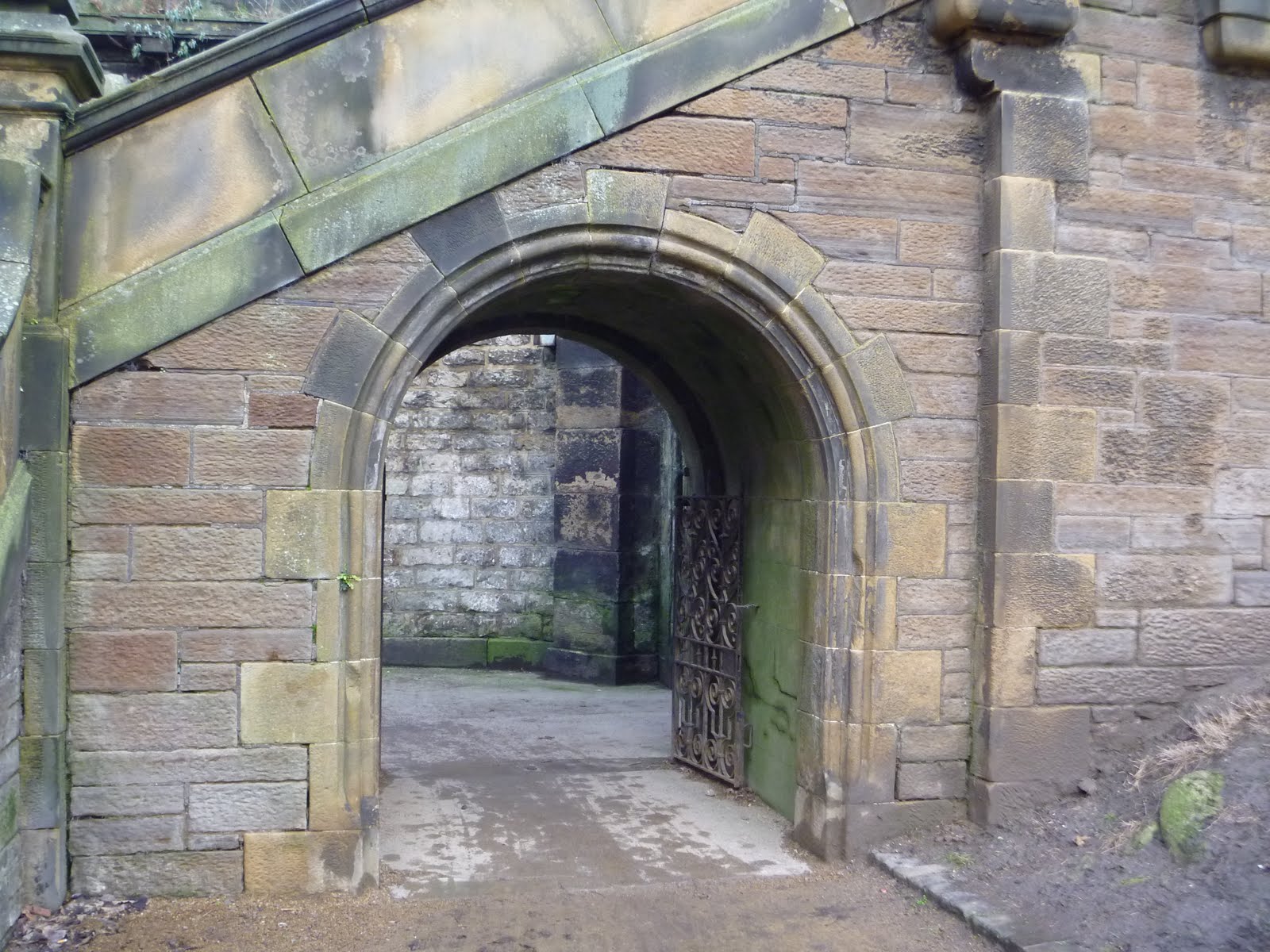


The Dene is a peculiar bridge and stairway over the Water of Leith in Stockbridge, Edinburgh. It featured in a scene in the excellent Edinburgh set horror film Outcast. I haven't been able to find out anything about the history of the Dene though, so if anyone knows anything please let me know!
There are lots of interesting bridges over the Water of Leith, you can see photos of some of the others here, here and here.
.
For Sunday Bridges
.
Sandy over on Witterings recently posted about the Water of Leith, you can read what he said and see his photos, here.
.
As ever, coloured text takes you to other pages, where you can find out more!
Friday, March 18, 2011
Benda Bilili
Benda Bilili is a documentary by Renaud Barret and Fiorent de la Tullaye that follows the rise of Staff Benda Bilili, a band made up of disabled musicians and street children from Kinshasa, Congo. It is an inspiring story, the band start by meeting up in Kinshasa Zoo (which looks a depressing place for the animals, but is the quietest space for the band to practice). Even though for a long time it has seemed that their band (and lives) were going nowhere, all the musicians are incredibly optimistic. The film makers manage to negotiate them some time in a recording studio and from there they move onto an album and appearances at World Music Festivals across Europe.
The lyrics of the songs come straight from the musicians lives, and cover topics like polio, education and life on the streets. The music is brilliant, typical central African rhythms, infectiously danceable, with often unique elements thrown in. The most impressive of these is the instrument played by Roger Landu, one of the street children in the band. It's made from an empty tin, a bent piece of wood and a wire, and he plays the most wonderful tunes on it. As the film progresses, we see a variety of customised versions of this instrument, all decorated beautifully for the various concerts the band gives.
You can find out more and listen to the band on their website here.
Benda Bilili is showing at the Filmhouse, Edinburgh until 24 March.
Tuesday, March 15, 2011
Secret of the Sands by Sara Sheridan
I was delighted to attend the recent launch of Sara Sheridan's new novel Secret of the Sands, as I had so enjoyed her earlier novel The Secret Mandarin (and you can read my review of that here).
Secret of the Sands is set in 1833. Lieutenant James Wellstead is travelling into the interior of the Arabian peninsula to find two of his shipmates who went missing on a surveillance trip.
In parallel the novel also follows the story of Zena, an Abyssinian slave girl bought by a desperate father to tempt his gay son into some semblance of heterosexuality. Zena and her master find a way to fooh his father and the household into thinking they are having a romantic relationship. Later, her master loses her in a gamble and she finds herself owned by Wellstead.
I thoroughly enjoyed the book. The setting is evoked beautifully and vividly and the characters and their relationships are well drawn. The issues of slavery and human rights are woven seamlessly into the story, so the reader is made to think about them without feeling as though we're being preached at. The characters of Wellstead and Zena are based on historical characters but the novel is a fictionalisation around the known historical facts. This is something that can annoy me if its not done well, but here (and in The Secret Mandarin) the historical facts feel to be respected within the telling of the story.
As there is a gay character in this book, this review qualifies for the LGBT Reading Challenge.
You can read Sara's article about gay rights in 1800s Arabia in the Guardian here.
Sara is taking part in Authors for Japan, her item for the auction includes a career consultation for a fledgling writer plus signed copies of both Secret of the Sands and The Secret Mandarin - you can find out more and put in your bid here
Sunday, March 13, 2011
Dean Village


A couple more photos of the beautiful Dean Village along the Water of Leith. I recently attended the Water of Leith Conservation Trust stakeholder conference, you can read more about that here.
You can see my other recent photos of Dean Village on this blog by following the links below:
Subscribe to:
Posts (Atom)